
Ustad Bismillah Khan - Essential Spiritual Experience in Kashi, Varanasi
Topics/Music & Cultural Heritage/Ustad Bismillah Khan

Ustad Bismillah Khan

Music
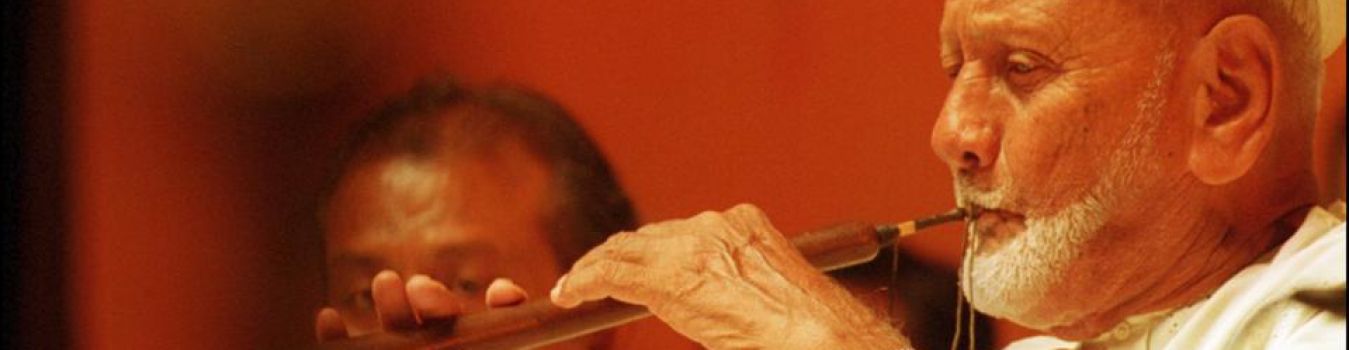
Bismillah Khan was born in Bhirung Raut Ki Gali at Dumrao, Bihar, in 1913 to Paigambar Khan and Mitthan into the family of musicians. Khan was bestowed with the title of ‘Ustad’ and earned many accolades like Bharat Ratna, Padma Vibhushan, Padma Bhushan, Padma Shri, Sangeet Natak Akademi Award, honorary doctorates from Banaras Hindu University and Viswa Bharati University, etc. Ustad Bismillah Khan was a great Shehnai player from India. His name was and will forever be associated with shehnai, the musical instrument that he made famous with his talent and deliberation in the post independent India. Khan belonged to a family of traditional musicians of Bihar who used to play in the courts of the princely states, which is why playing shehnai came very natural to him. He was brilliant at what he did - the reason why he had always played at the important national events for national audience like the first Indian Independence Day and first Republic Day. Khan with his simplicity, love for music and straightforwardness did not only become a national favorite but also gained a lot of popularity and love from the west. For his creativity and mastery in his art, Khan was bestowed with the title of ‘Ustad’ and earned many accolades like the Bharat Ratna, Padma Vibhushan, Padma Bhushan, Padma Shri, Sangeet Natak Akademi Award, honorary doctorates from Banaras Hindu University and Viswa Bharati University.

Deep Dive: Ustad Bismillah Khan

Ustad Bismillah Khan, the Bharat Ratna awardee, brought the Shehnai from the marriage mandaps to the world stage. Born into a family of court musicians, he spent his life in the narrow lanes of Varanasi, find inspiration by the banks of the Ganges.

His music was a bridge between faiths, as he often played at the Kashi Vishwanath Temple despite being a devout Muslim. For music lovers, visiting his home in Kabir Chaura is a pilgrimage into the heart of the Benaras Gharana.

Expert Insights for Your Visit

Varanasi is best explored with an open heart and a slow pace. The city reveals its secrets to those who stay long enough to observe the subtle shifts in the river's light and the rhythm of the daily rituals.

We recommend pairing your visit to Ustad Bismillah Khan with a quiet walk through the nearby ancient ghats or a sampling of the city's legendary culinary heritage.

Curated by Hospes India

As Varanasi's leading destination management experts, we ensure that your visit to Ustad Bismillah Khan is authentic and seamless.

1
Verified Historical Context
2
Reliable Transport Logistics
3
24/7 Traveler Assistance

At Hospes India, we believe that travel should be transformative. From arranging priority darshan at the temples to booking luxury river cruises on the Ganges, we handle the logistics so you can focus on the experience. Let us help you discover the timeless magic of Varanasi, where every corner holds a piece of eternity.

Experience Ustad Bismillah Khan in Motion

Videos courtesy of YouTube. Explore more of Kashi through our curated visual guide.

Frequently Asked Questions

Can we attend a live performance?

Concerts often happen at music ashrams, heritage hotels, and during festivals. The annual 'Sankat Mochan Sangeet Samaroh' at the Sankat Mochan Temple is a must-attend event for music lovers.

Are there music classes available?

Yes, Varanasi's Guru-Shishya tradition continues. You can find masters for Tabla, Sitar, Shehnai, and Indian classical vocal music in the lanes of Kabir Chaura.

What is the significance of the Benaras Gharana?

The Benaras Gharana is one of the most prestigious schools of Indian classical music, known for its unique style of Tabla and Thumri.

Is this related to spirituality?

Absolutely. In Kashi, music is 'Nadopasana'—the worship of sound as a path to the divine. Most classical performances are dedicated to Lord Shiva.

What is the Benaras Gharana style?

It is a comprehensive musical school known for its distinct style of Tabla playing and its specialty in semi-classical forms like Thumri and Dadra.